
Celebrate diversity at Hesston College with annual Cultures Fair
General
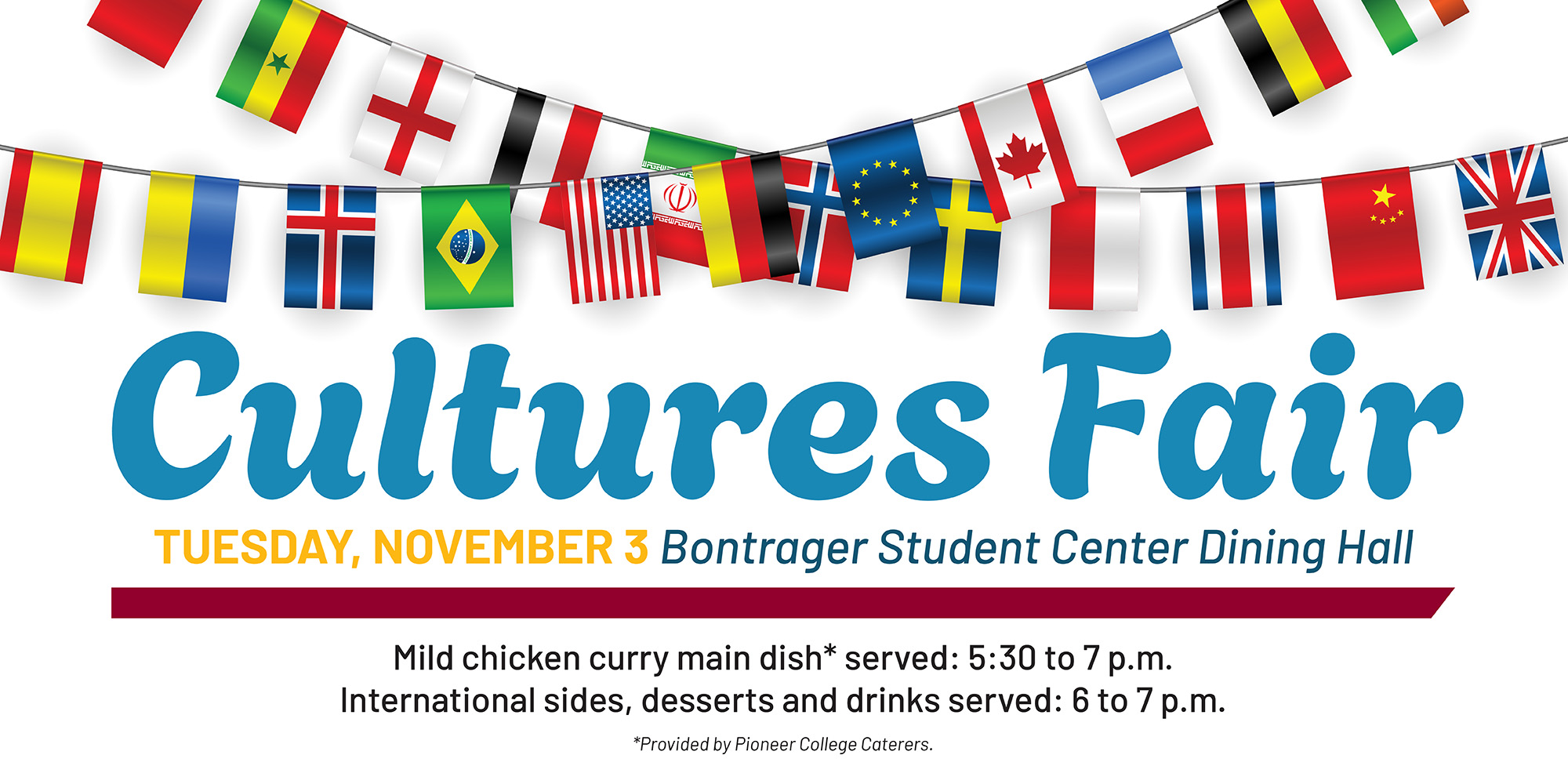
Hesston College will celebrate the many cultures represented on campus with its annual Cultures Fair on Tuesday, November 3, in Bontrager Student Center dining hall. The event features international foods to showcase the diversity of the Hesston College community. Admission is $11 per person and open to the public. RSVPs are requested by Nov. 1 at hesston.edu/culturesfair2026.
Guests are invited to taste, learn and celebrate the variety of global traditions that make Hesston College unique. A mild chicken curry main dish will be served by Pioneer College Caterers from 5:30 to 7 p.m., while international sides, desserts and drinks will be available from 6 to 7 p.m. Students will share flavors and wear traditional clothing from their cultures, reflecting Hesston’s global connections and welcoming spirit.
“We’re really looking forward to a night of internationalization,” says Kyle Timmermeyer, international student support coordinator. “We’re grateful to Hesston College and the Hesston community for their warm embrace of international students and the cultures they represent.”
This year’s event continues to build on Hesston College’s commitment to cultivating a Christ-centered community that values peace, justice, equity and inclusion. With students representing 30 countries on campus, the Cultures Fair provides an opportunity to connect across many of those borders and foster understanding in a joyful, welcoming setting.

Hesston College Softball invites community to Larktoberfest for free fall fun
Athletics
General
Hesston College is inviting families and community members of all ages to enjoy an evening of fall festivities at Larktoberfest: Fall Fun at the Diamond on Friday, October 30, from 4 to 8 p.m. at Bess Mullet Field on the Hesston College campus.
Hosted by the Hesston College Softball team, the event brings together fall-themed activities, family entertainment and Lark softball for an evening of community fun. Admission and activities are free and open to the public.
Guests can enjoy trunk-or-treat, a bounce house, face painting, a costume contest, music and a variety of games and activities throughout the evening. Food trucks will also be on site with food available for purchase.
The idea for Larktoberfest grew out of the softball program's desire to create a new campus tradition that brings Hesston College and the surrounding community together.
“Our goal is to build something that grows each year and becomes an event that students, families, alumni and members of the Hesston community look forward to every October,” says Alex Butterfield, Hesston College softball head coach.
Adding to the festivities, the Hesston College softball team will take the field against Fort Hays Tech Northwest in a fall matchup beginning at 5 p.m. Community members are encouraged to cheer on the Larks while enjoying the activities surrounding the field.
Whether stopping by for trunk-or-treat, spending the evening with family or catching some Lark softball, Larktoberfest offers something for everyone.
Admission and all activities are free, and no registration is required. Hesston College welcomes the greater Hesston community to join the celebration and enjoy an evening of fall fun at the ballpark.

Hesston College receives grants totaling nearly $4 million for tech, student experience upgrades
Business
General
The Hesston College campus looks forward to upgrades after learning they will receive three grants for a combined total of nearly $4 million. These include a FEMA grant for $149,999, a Congressionally Directed Spending (CDS) grant for $800,000 and a Title III grant for $2.9 million.
With Hesston College’s strategic plan shift in fall 2023 to focusing on bachelor’s degree programs, the need to make larger technology investments became apparent. The college later enlisted the help of a consultant to aid in establishing a grant-writing culture, and that investment is paying off.
“We knew this transition toward four-year professional degree programs would require investment beyond our own capacity,” shares President Mark Landes. “We now have funding to upgrade our entire technology infrastructure, which will serve to transform Hesston College over the next five years. This is an investment in our students whose experiences will see direct improvement as a result of our grant funding.”
Technology updates are the common thread between the three grants.
The FEMA grant for $149,999 will be awarded over three years to improve campus safety. This grant allows for key card entry to be set up at both of HC’s dorms, Erb Hall and Kauffman Court, replacing the need for physical keys. The upgrade provides added safety functionality with the ability to centrally lock down exterior dorm doors in case of an emergency. The project is set to begin before the end of the calendar year with hopes for completion by the start of the fall 2027 academic year.
The CDS grant for $800,000 will also be awarded over a three year period. The primary goal of this grant is to launch a cybersecurity bachelor’s degree program, a program that Vice President of Academics Ross Peterson-Veatch believes is the expression of Hesston’s new academic model and will allow the college to serve the community in a way that participates in cultural and economic development of this region.
“In our new model, we want to ensure that students gain real world experience in all of our academic programs,” Peterson-Veatch explains. “The technology infrastructure improvements built into this program’s launch will make it possible for us to provide actual services to community partners. This foundation will help us create future programs that will support broader community aims.”
In addition to hiring a program director, the CDS funds include a large technology investment which will go toward new computers for the computer lab, new fiber optic cables in several campus buildings and establishment of a community-facing Security Operations Center.
The $2.9 million Title III grant will be awarded over a five year period to further advance the college’s four-year academic vision and IT roadmap, strengthening career pathways and institutional capacity. A portion of funding is designated to create the Pathways Center for Career and Vocation within the already existing Smith Center. This center will serve as a centralized hub connecting students, academic programs, employers and other workforce partners.
“The director of the Pathways Center will coordinate internships, work-based learning experiences, employer engagement, career coaching, mock interviews, networking opportunities and other workforce readiness activities,” says Landes. “By embedding career development into the student experience, the college will strengthen student retention, increase career readiness and improve employment outcomes after graduation.”
The grant also includes significant investment into technology modernization of the campus management platform, wireless infrastructure and classroom technology, among other items.
“These investments in Hesston’s technology infrastructure will clearly strengthen our foundation, but equally important is how we will create stronger connections between our students’ experiences and the job market,” Landes shares. “It’s critical that we are creating new pathways for our students into the job market and that we are equipping them the best we can for the careers that lie ahead as they leave Hesston College.”
Recognizing the resource challenges with technology investment over the past several years, Landes says the college was fortunate to have a local alum, Don Weaver, volunteer to lead a task force beginning last year to establish a technology roadmap for HC. While funding proved to be the biggest hurdle in reaching the desired technology outcomes, this roadmap is now fully achievable with funding in place.
“Providing an attractive environment for our students and employees requires significant investment in technology. With plenty of other strategic initiatives in motion and needing to be successful, our technology needs to facilitate and enhance our strategic efforts, not limit them,” Landes explains. “Implementation of the Title III Grant over the next several years will provide a much stronger foundation from which Hesston College can operate efficiently and launch new initiatives.”

Hesston College features ‘Color Ingrained’ exhibit and free workshop with Susan Fox
Art
Hesston College is showcasing the work of Newton, Kan., printmaker and mixed media artist Susan Fox in “Color Ingrained - Hand-Pulled Prints by Susan Fox,” on display Oct. 1 to 30 in Laban Peachey Center’s Regier-Friesen Gallery.
Fox’s work explores the textures, light and color found in nature through relief prints, collagraphs, monoprints and mixed media. Her artwork draws inspiration from naturally occurring textures and the way light reflects across the world.
The community is invited to meet Fox during an artist reception Wednesday, Oct. 14, from 4 to 5 p.m. in the Regier-Friesen Gallery. Following the reception, Fox will lead a hands-on printmaking workshop from 5 to 6:30 p.m.
The workshop is free and open to all, providing participants an opportunity to learn more about Fox’s creative process and try their hand at printmaking. Space is limited.
“Color Ingrained” will be open for viewing throughout October during regular gallery hours 10 a.m. to 5 p.m., Monday through Friday.
For more information about upcoming Hesston College arts events, visit hesston.edu/paschedule.
Hesston College enrollment climbs for third consecutive year
General
For the third straight year, Hesston College is excited to celebrate enrollment growth as fall 2026 census numbers continue to climb, demonstrating positive momentum in recruitment and improved retention.
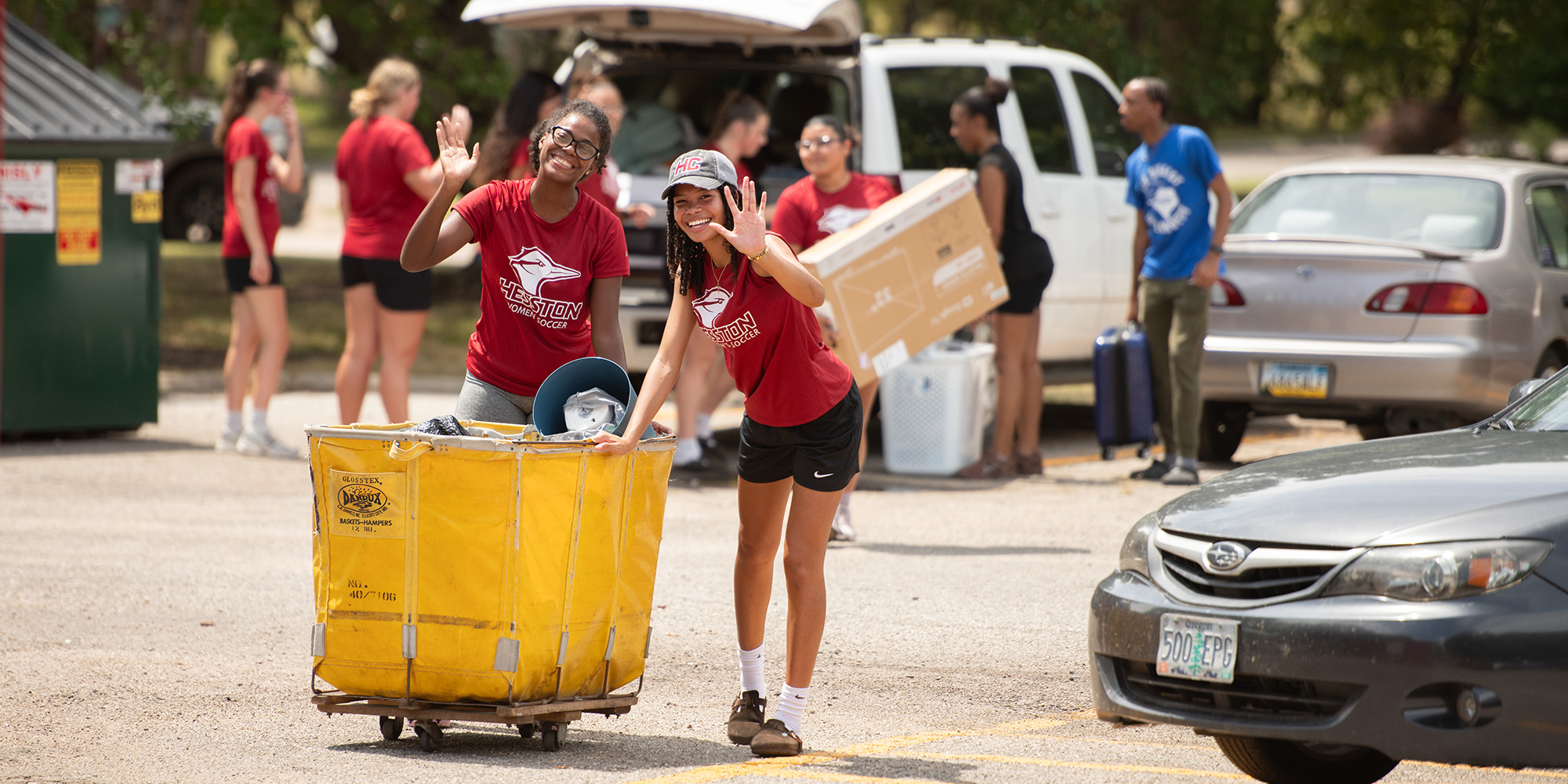
Total student headcount this fall surpassed 400 for the first time since 2018 with 407 students, up from 394 in fall 2025. Residential life continues to experience strong growth as well, with 362 students living on campus. An increase from 338 in fall 2025, this marks the college’s highest on-campus student count since 1989.
International student enrollment is back up with 62 students representing 28 different countries on campus this semester. The fall 2025 count dipped to 54 international students primarily from federal visa approval delays during that recruitment cycle.
Another highlight from this year’s census is the retention rate increasing by 13 percentage points, a huge jump in one year. After identifying this as an area for improvement last year, the college is grateful to see the investments made into the student experience and overall student success quantified through this uptick in retention.
“As part of our shift from a two-year to four-year model, we anticipated some early challenges with retention as we narrowed our academic focus to four-year professional degree programs and shifted athletics from the two-year NJCAA [National Junior College Athletic Association] to the four-year model with NAIA [National Association of Intercollegiate Athletics],” President Mark Landes explains. “Entering our second year with clarity in our model and more investments in the four-year student experience, we are excited to see this retention improvement as a key indication our students value their experience at Hesston College.”
Not only are more students choosing to stay at HC, but a recent partnership with USD 460 is allowing Hesston High School (HHS) students opportunities to get their foot in the door at Hesston College now through a dual credit agreement that began this semester.
“We have 45 dual credit students from HHS taking math courses this fall and expect a similar number in the spring,” shares Landes. “We greatly appreciate this partnership opportunity with HHS and see more potential in the future as we both look to serve our students and community well.”
Hesston College theatre director celebrates 50th production
General
Theater
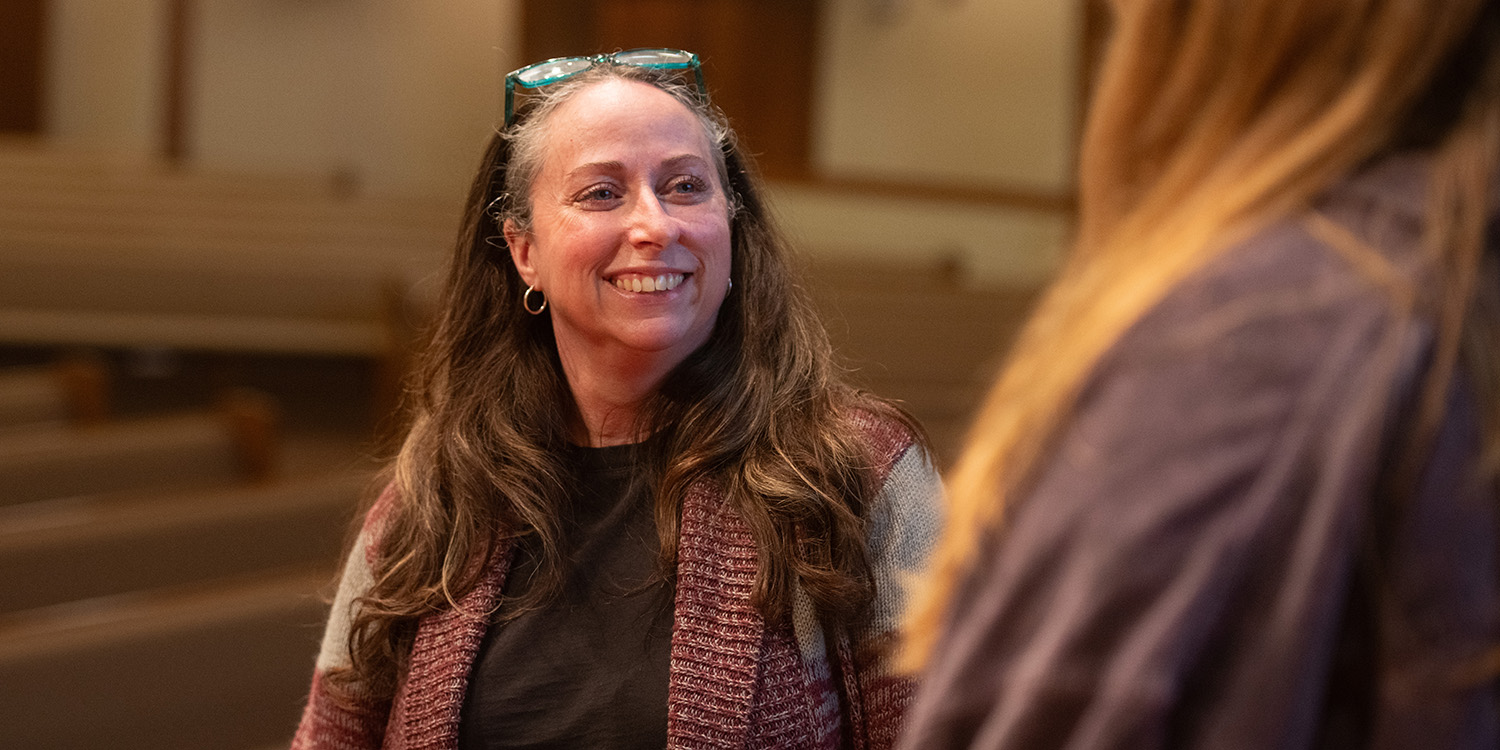
Theatre has a way of meeting people in the middle of life — celebrating, grieving, connecting and telling stories that matter. For Hesston College Director of Theatre Rachel Jantzi, those moments have been at the heart of the numerous productions she has directed at Hesston College over the years. Her 50th production, “The Children’s Hour,” will take the stage October 1 to 4.
A Newton, Kan., resident, Jantzi has spent 17 years helping Hesston students bring stories to life on stage. Along the way, some productions have become deeply personal.
Two weeks before Hesston’s production of “Working” opened in 2016, the Hesston community was shaken by the shooting at Excel Industries. Jantzi changed the concept of the musical, turning it into a tribute to working people and first responders of Hesston.
“It was a way to give thanks for this small community,” she shares.
Another production, “Silent Sky,” followed the story of 19th-century astronomer Henrietta Leavitt and ended with the entire theatre illuminated with stars. Jantzi dedicated the show to her uncle Jim who worked as a senior systems engineer for the International Space Station before passing away that same month.
Those productions are just two of the many memories Rachel carries from her 50 shows at Hesston.
Jantzi’s Hesston theatre journey began in 2009 when she was asked to step in as a favor to the director at the time for “Forever Plaid.” The four-person production was small, but it quickly became a memorable experience. Jantzi also choreographed the show, working with four talented young men who were not natural dancers.
“They worked so hard and were practically a quartet of Fred Astaires by the time we opened,” Jantzi recalls. “I was so proud of their work.”
For Jantzi, the most meaningful part of 50 productions isn’t necessarily the shows themselves. It’s the students.
She remains connected with many of her former students. Some still text her with life updates, send wedding invitations and birth announcements or call to tell her about a show or film they are working on.
“I have taught some truly amazing humans,” Jantzi says. “My students have taught me many things, but mostly to be present, to not undervalue our impact and to have fun.”
Those relationships have also found their way back to Hesston. Former students have returned to work with Jantzi as choreographers, designers, technicians, guest presenters and summer counselors.
“I hope they always feel at home in our space,” she says.
After 50 shows, Jantzi still sees theatre as a blessing passed from one person to another.
“I think of a show as a gift that has traveled through many hands; from the playwright, to the director, to the cast and crew and finally to the audience,” she explains. “I enjoy passing that show on to my actors through rehearsals, and I’m excited to see the result of their work as they hand it off to the public.”
And while 50 productions is a major milestone, Jantzi isn’t taking much time to celebrate.
She’s looking forward to sleeping, making it to some of her husband Scott’s soccer games, returning to Thursday night trivia at Moxie’s and then beginning rehearsals October 19 for HC’s Christmas show — production number 51 is already on the horizon.
Hesston College student wins inaugural Peace Talks competition
Bible and Ministry
General
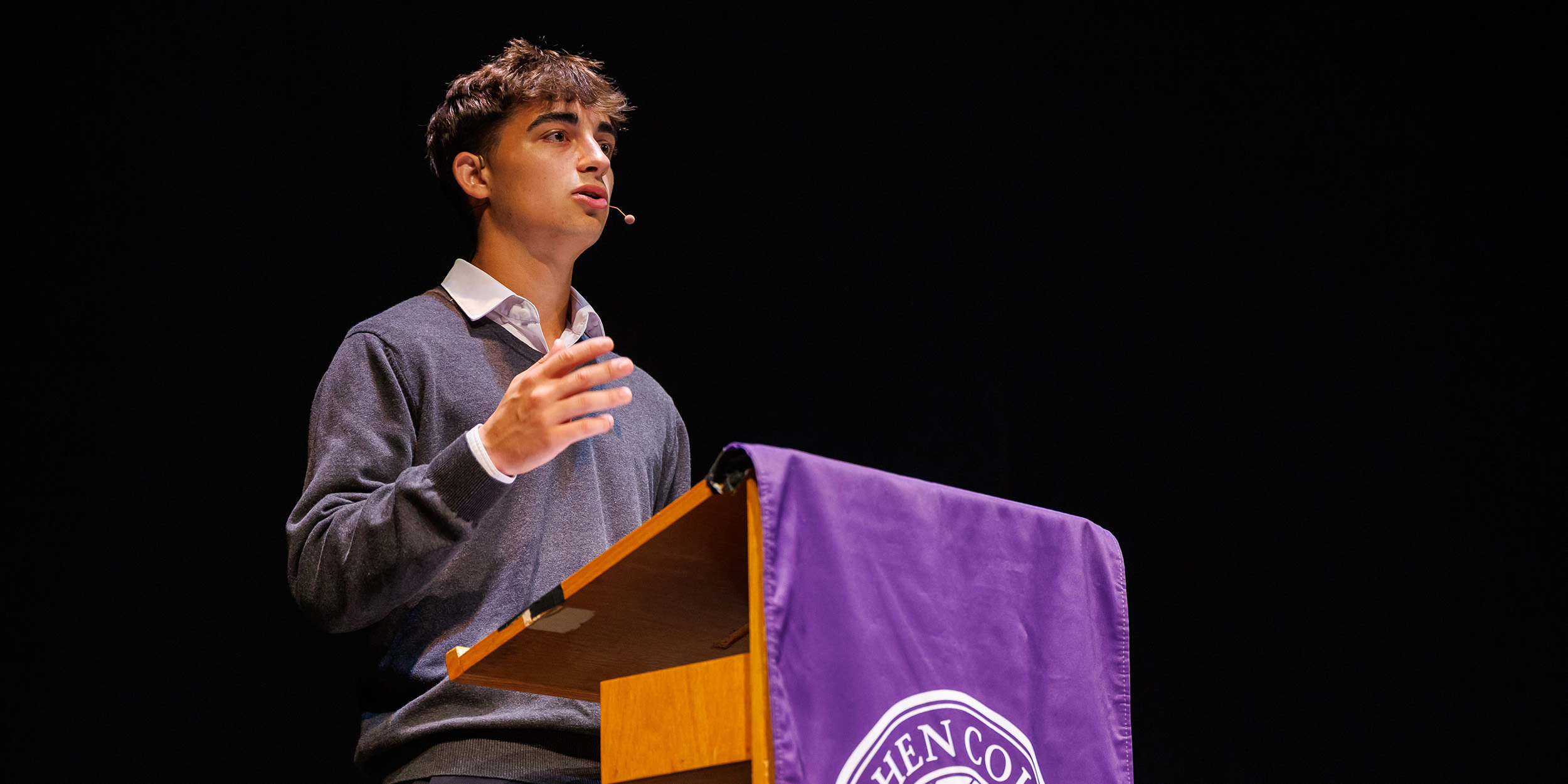
Hesston College sophomore Mateo Gonzalez turned a personal connection to restorative justice into a first-place finish at the inaugural Peace Talks competition Saturday, September 19, at Goshen College in Goshen, Ind.
Gonzalez, an engineering student from Madrid, Spain, was one of five college students invited to compete in the first-year event. His speech, “More Than a Sentence: Exploring Restorative Justice,” challenged listeners to consider how justice can extend beyond punishment.
“My speech explores the limitations of purely punitive justice and advocates for a restorative approach that fosters healing and true accountability,” Gonzalez explains. “Through personal reflections, biblical examples like Jesus and Zacchaeus and the inspiring story of Reginald Dwayne Betts, I argue that people are more than their worst mistakes and deserve the chance for redemption.”
For Gonzalez, the subject was more than an academic exercise. His interest in restorative justice began with a story much closer to home.
“I think what made my speech stand out was the personal connection behind it and the strong foundation of the topic itself,” Gonzalez says. “My speech was inspired by a documentary my mom made about a juvenile intervention program (Before It’s Too Late), which allowed me to speak with genuine passion and real conviction about restorative justice.”
Gonzalez’s path to the Peace Talks stage began last semester on the Hesston College campus through his participation in the C. Henry Smith speech contest in May.
“When I found out I was selected to advance to the national Peace Talks competition, it was definitely a pleasant surprise, but it also motivated me to start refining and practicing my speech again for the next contest,” Gonzalez shares.
For its inaugural year, Peace Talks used participation in the C. Henry Smith contest as the basis for inviting students to compete. The two competitions remain separate, with the C. Henry Smith contest continuing independently. Gonzalez has also entered that competition via video submission; results are expected to be announced in October.
Hesston College Campus Pastor and Bible Professor Nick Ladd accompanied Gonzalez to Goshen and watched his speech continue to develop throughout a full day of workshops, coaching and preparation, all of which Gonzalez soaked up with a positive attitude and coachable spirit. Ladd notes that while Gonzalez brought together a real-life story, supporting information, biblical examples and a relatable call to action, his approach to the preparation process also stood out.
“By 7 p.m., when the contest started, the contestants were all very tired and worn out,” Ladd explains. “I believe another thing that helped Mateo in that moment was his experience from playing soccer at HC. He knows what it is like to be exhausted at half time of a game and still pull together his strength, energy and courage to go play hard for another 45 minutes for the second half.”
After hours of preparation and facing a strong group of fellow speakers, Gonzalez says the nerves of the moment quickly gave way to a connection with those listening.
“Performing in the final round was an incredible experience,” Gonzalez recalls. “Naturally, there were some nerves given the stage and the high level of all the contestants, but once I started speaking, I felt deeply connected with the audience and to the message I was sharing.”
That connection ultimately resulted in Gonzalez being named the first winner in the competition’s history — an outcome he wasn’t expecting as he waited for the results.
“When I heard my name announced as the winner, it was a big surprise because all of the other contestants did such a fantastic job,” Gonzalez says.
The victory also gave Gonzalez an opportunity to represent Hesston alongside students from other established four-year colleges. For Ladd, seeing a Hesston student distinguish himself in this competitive field was especially meaningful.
“It was such an honor and privilege to walk alongside Mateo for this event,” Ladd says. “I hope that his experience will also help bolster excitement for other students to participate in the contest this year.”
Beyond the first-place result, Gonzalez came away from Goshen valuing the people he met and the experiences surrounding the competition itself.
“Peace talks was an incredible experience and opportunity not only because of the well prepared contest itself, but also because of all the activities and workshops we did,” explains Gonzalez. “I will never forget the people I met and the great time I had in Goshen.”
Placing second in the Peace Talks competition was Katherine Brown of Tabor College (Hillsboro, Kan.) with her speech titled, “The Woman on the Corner: Prostitutes are People too.” Other finalists included Caoimhe Farrell of Goshen College, Sophia Kauffman of Conrad Grebel University College (Waterloo, Ontario) and Preston Vicenzi of Bethel College (North Newton, Kan.).
Peace Talks is a new annual public speaking event focused on faith-based storytelling about peace and justice and is part of More Than Just Stories, a Goshen College initiative funded through a five-year, $5 million grant from Lilly Endowment Inc. For more information about the competition, Gonzalez’s speech and the other finalists, visit the Peace Talks contest recap.
Photo (courtesy of Peter Ringenberg Photography):
Mateo Gonzalez of Hesston College won first place at the inaugural Peace Talks contest held at Goshen College on September 19 for his speech, “More Than a Sentence: Exploring Restorative Justice.”
Mateo’s speech: More Than a Sentence
At sixteen years old, Reginald Dwayne Betts participated in a carjacking. He was sentenced as an adult and spent eight years in maximum-security prisons. For years, Reginald imagined his freedom. A second chance. A new beginning. But when he finally walked out of prison carrying a small bag in his hand, he discovered something painful: although his sentence had ended... society’s judgment hadn’t. For many people, he was still “the criminal.” Still dangerous. Still defined by the worst thing he had ever done.
I want all of you, just for a moment, to think about the worst mistake you have ever made. Not the mistake everyone knows about. The one you truly regret. The moment you wish you could erase (big pause) . Now imagine that from this day forward, no one ever lets you move beyond it. In every new relationship, people see only that mistake. They define you by it forever. For many people who have caused harm, that is exactly what life feels like. And maybe that’s what troubles me most. Not only what people do when harm occurs... but what happens afterward. How quickly we punish. How easily we label.
Because when trauma strikes a person, a family, or an entire community, what kind of justice is truly capable not only of punishing wrongdoing, but of restoring healing, dignity, and peace?
Today, we live in a culture deeply shaped by punishment without restoration. We see it in schools, communities, and everyday relationships. A student cheats once and suddenly becomes “the cheater.” A person leaves prison after years... but society never allows them to leave their past behind. Punishment isolates. Restoration reconnects. And while punishment may satisfy anger for a moment, we must ask ourselves something deeper: does it actually heal? If punishment leaves victims still hurting, offenders hopeless, and communities divided — has justice truly been served?
The numbers tell us a painful story. According to the U.S. Department of Justice, nearly 67% of released prisoners are arrested again within three years. Behind that number are real people and families. Punishment alone often becomes a revolving door. But restorative justice offers something different. Research consistently shows that when victims and offenders participate in restorative dialogue processes, victim satisfaction increases and reoffending decreases. This isn’t simply an idealistic theory. It is a vision of justice that creates real accountability while also creating the possibility of healing. Maybe this is where our idea of justice begins to change. Because perhaps justice was never meant only to punish evil... but also to restore what evil has destroyed. What if justice could do more than punish? What if accountability and healing were not opposites?
However — I want to be honest with you. Restorative justice isn’t simple. For a victim to sit across from the person who hurt them — to speak, to remember, to reopen that wound — takes extraordinary courage. Some victims are not ready for that conversation. Some may never be. And restorative justice recognizes that too. But it still asks us to believe something difficult: that human beings are more than the worst thing they have done. That even after deep harm, healing is still possible. That the wound is not always the final word.
Like Zacchaeus in the Gospel of Luke, who after recognizing the harm he had caused chose not only to apologize but to restore what he had taken, restorative justice asks people to seek repair instead of simply avoiding consequences. But I want to stay with Zacchaeus for just a moment longer, because what impresses me most isn’t the repayment. It is what happened before that. Jesus looked up into that tree and called him by name. Not “the tax collector.” Not “the sinner.” By name. In that single act, Jesus refused to let a label become a permanent identity. And perhaps that is where restoration always begins.
This choice is not only made in prisons or courtrooms. Growing up in Spain, I remember that when conflicts happened in school, the goal wasn’t always immediate punishment. Sometimes, instead of simply sending students home, teachers would bring people together to talk and to confront the harm directly. Looking back, those moments taught something deeper than punishment: they were teaching responsibility, dialogue, and restoration. We live in a generation that has grown up with screenshots, where a message sent at fifteen can define you at twenty-five, where the internet never forgets — and rarely forgives.
And maybe we, more than any generation before us, understand what it means to be reduced to a single moment — to be seen as a post, a mistake, a label, and never as a person still becoming. Even here, in communities like Hesston College, we face this question every day. When conflict appears in dorm rooms, classrooms, friendships, or teams, do we choose the quick punishment that isolates... or do we have the courage to pursue the conversations that restore?
And into a world that also knew how to reduce people to their worst moment, Jesus walked differently. Again and again, Jesus challenged condemnation without ignoring harm. When the woman caught in adultery was brought before Him, surrounded by people ready to stone her, Jesus responded: “Let any one of you who is without sin be the first to throw a stone.” He did not deny wrongdoing. But He also refused to reduce a human being to their worst mistake. The crowd dropped their stones and walked away. And when they were gone, Jesus didn’t move on quickly. He stayed. He looked at her — truly looked — and said: “Neither do I condemn you.” Not because her wrong didn’t matter. Not because what happened was acceptable. But he said: you are still more than this. Go, and begin again. That word — go — is not an erasure. It is an invitation. To a new beginning that punishment alone could never offer.
Perhaps that is what Christian peace truly requires from us. Not the absence of accountability and not excusing wrongdoing— but the difficult work of healing broken relationships and believing that redemption is still possible. Peace is more than the absence of violence. Peace is reconciliation.
Imagine a society where every mistake becomes a permanent identity. Where shame follows people longer than any sentence. Where communities know how to punish... but no longer know how to heal. Now imagine something different. A society where victims are truly heard, where accountability still exists but so does the possibility of transformation. Where justice doesn’t end with suffering, but leaves room for healing.
Reginald Dwayne Betts didn’t remain trapped in his worst mistake. Today, he is a Yale-educated lawyer and an award-winning poet. His story forces us to confront a difficult question: how many lives do we lose when we decide that people can never become more than their worst moment?
Reginald Betts still carries a small bag everywhere he goes. Not the one from prison — a different one. A bag with notebooks, drafts, words he is still writing. Because the story didn't end when he walked out of that prison. It began. And maybe that is the deepest truth restorative justice asks us to hold: that every person still has a story that is not finished yet. That the worst chapter cannot be the last one. That justice — real justice — leaves room for the next page to be written.

It started with a pencil: Dick and Ruth Ann’s story
Alumni and Development
General
Dick and Ruth Ann’s Story
When Ruth Ann (Detweiler) ’60 and Dick Toews ’60 first came to Hesston in 1958, they had no idea the small Kansas town would become the place where they would build their lives together.
They came to Hesston College as students, met during their first year and married in 1961. They raised a family, worked in the community, served their neighbors and opened their home to generations of Hesston College students.
Now, 65 years after their wedding, Hesston is still home.
“There were some rocky parts in life, but there were some really good ones,” Dick said.
“Most of the good ones are here,” Ruth Ann elaborated. “Family, friends and faith are what's important to us and have helped us through our time together.”
It started with a pencil
Dick and Ruth Ann’s story began before they officially met.
Ruth Ann remembers seeing Dick when their high schools played against each other in softball. She was attending Corn Bible Academy, while Dick was at Oklahoma Bible Academy.
“I went over with our softball team to play softball at Corn,” Dick said.
“I saw him, and I said, ‘Oh, wow, he’s cute,’” Ruth Ann shared.
Unfortunately, Ruth Ann soon learned Dick already had a girlfriend.
“His cousin happened to be standing by me,” Ruth Ann explained, “and she said, ‘Oh, don’t look. He’s had a girlfriend for three years. They’ll be getting married when he’s out of school.’”
That didn’t stop their paths from crossing again.
When both arrived at Hesston College in 1958, they met during Walk a Mile, what used to be a traditional Opening Weekend activity where students had the opportunity to meet one another.
“I did go to him, and we started talking and laughing,” Ruth Ann said.
She noticed he was wearing a ring on his little finger, but that didn’t keep them from enjoying the evening.
Later, Ruth Ann spotted Dick walking down the sidewalk while she was in the library.
“I got my pencil out and dropped it down the window,” she said.
The pencil got his attention.
From college students to newlyweds
The two eventually began dating, then they were married May 19, 1961.
Their early years together were filled with small, ordinary moments that would eventually become cherished memories.
For a short time after their wedding, they even lived in the basement of Ruth Ann’s parents while waiting for their apartment to become available.
“Her parents were just super, super nice,” Dick said.
Dick remembers Ruth Ann’s resourcefulness during their early years. When they needed a car, they were able to pay cash because Ruth Ann had saved her money.
“That was kind of one of our things, though,” Ruth Ann said. “I’m a tight person.”
Dick chuckled.
Over the years, they learned how to navigate the ordinary challenges of marriage — and plenty of unexpected ones.
Dick spent decades serving with the local ambulance department, which meant he could be called away at any time. He remembers having his keys, wallet and other necessities ready so he could get out the door quickly. His goal was to make it from the house to town in three minutes. That dedication occasionally created some interesting moments at home.
One night, Ruth Ann had rearranged the bedroom furniture. Dick, exhausted after working multiple jobs, came home and went to bed without noticing. Later that night, his pager went off. He jumped out of bed, ready to respond, and suddenly found himself disoriented.
Ruth Ann had moved the bed. After all those years, they learned to laugh at the unexpected parts of life.
Hesston became home
When Dick and Ruth Ann arrived in Hesston, the town had around 800 people. They watched the community change over the years, and today, its population is nearly 4,000.
While they changed alongside it, Hesston College remained a major part of their lives. Ruth Ann worked at the college for 31 years in the registrar’s office. Dick worked in maintenance for several years before eventually dedicating much of his career to emergency services.
Their connection to the college extended beyond their jobs. For more than 40 years, they lived in a house across from the church on campus. Their home became a place where students could stop by, visit and spend time with them.
“They came out to our house a lot,” Ruth Ann recalled.
That connection to Hesston College also became part of their family’s story. Their sons, Bob ’83 and Rick ’85 ’86, attended Hesston College, and their son Randall worked at the college as an environmental services manager. Their grandson Trevor ’13 and granddaughter Julian ’21 also attended as well.
For Ruth Ann, those relationships became some of her favorite memories. Even years later, she remains in contact with some of the students she met through her work at the college.
What began with two students arriving on campus in 1958 grew into a connection that reached across generations — through education, work, friendships and family.
What they would tell today’s students
When asked what advice they would give current Hesston College students, Dick pointed back to the relationships he and Ruth Ann formed during their college years.
“A lot of our college experience was the social interaction with different people,” he said.
For Dick and Ruth Ann, those relationships did not end when they left college. They continued through church, work, community service, family and friendships.
Their story is a reminder that college can become much more than an education. It can be where people find lifelong friends, discover a community and begin the relationships that shape the rest of their lives.
For Dick and Ruth Ann, that story began in Hesston in 1958. It continued through 65 years of marriage. And it is still being written.
They came to Hesston as two young college students. They stayed. And somewhere along the way, Hesston became home.

Hesston College to celebrate 60 years of nursing at Homecoming 2026
General
Alumni, friends, families and community members are invited to return to the Hesston College campus for Homecoming 2026, Sept. 25 to 27. The weekend will celebrate the Hesston Experience through reunions, traditions, athletics, student showcases and the 60th anniversary of Hesston College’s nursing program.
The Nursing Showcase will commemorate six decades of nursing education. Visitors will have the opportunity to learn about the program’s history and tour Bonnie Sowers Nursing Center, including its simulation labs and learning technology.
“The Nursing Showcase is an opportunity to celebrate that history while also looking toward the future,” shares Gregg Schroeder, director of nursing education and health studies and HC class of ’86 nursing alum. “I hope visitors experience a sense of pride in what Hesston’s nursing program has accomplished and get a glimpse of how nursing education has evolved.”
From simple simulated patients to high-fidelity manikins and virtual and augmented reality, nursing students now have access to technology that helps them develop hands-on skills, clinical reasoning and judgment before interacting with patients in clinical settings. Schroeder says that while the technology has changed, the heart of Hesston’s nursing program remains the same.
“Most importantly, I hope visitors see that we still develop the human side of nursing — the knowledge, clinical judgment, compassion and commitment that we nurture during their time at Hesston,” Schroeder explains.
In addition to celebrating the nursing program, Homecoming weekend will offer a variety of opportunities for alumni, students, families and friends to reconnect with the Hesston community.
Other Homecoming highlights include Passport to Our Global Community, softball and baseball alumni games, a reverse Druber’s run, the Biblical Literature in a Modern World session and the annual Homecoming Family Festival.
While there is much to do and enjoy during Homecoming 2026, Lisa (Hostetler) ’90 Longacher, vice president of advancement, shares what she is most looking forward to.
“The Passport to Our Global Community session showcases a few of our international students who will share about their respective cultures,” she explains. “This is a fun way to hear from our students as well as to learn about different cultures.”
The weekend will also bring together two Hesston traditions: alumni connection and ice cream. Clay’s Cones, founded by John ’11 and Saralyn (Murray) ’19 Oyer, will sell ice cream on Friday night during the volleyball game and reverse Druber's run. Then Salted Creamery, founded by Kendra Burkey ’00, will sell ice cream Saturday night during the Family Festival and men’s soccer game.
“What do you do when there are two local businesses started by HC alumni,” asks Longacher? “You invite each of them to come and serve ice cream both nights of Homecoming!”
A complete schedule of Homecoming Weekend 2026 events and registration information is available at hesston.edu/homecoming.